
Scientific Climate Ratings Newsletter. Issue 4, November 2026

We are proud to open this issue with a defining milestone. Scientific Climate Ratings is now registered with the European Securities and Markets Authority (ESMA) as an ESG rating provider under Article 5 of the EU ESG Ratings Regulation.
This milestone reflects our commitment to the rigour, transparency and independence behind our ratings, and positions us at the forefront of the EU’s newly regulated ESG ratings landscape. For investors, it means climate risk assessments they can rely on with confidence, built on science and subject to EU regulatory requirements.
It arrives alongside ClimateMetrics v3, a major upgrade that quantifies how climate risk affects asset value and credit risk, and our continued expansion across sovereigns, real assets and, looking ahead, corporates.
In this issue, we unveil what we have been developing behind the scenes, the insights emerging from our research, and the next chapter in our journey.
Product Release:
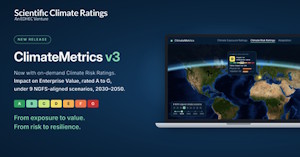
ClimateMetrics v3: From climate exposure to financial impact
Scientific Climate Ratings has launched ClimateMetrics v3, introducing on-demand Climate Risk Ratings that quantify how physical and transition risks affect asset value and credit risk across nine NGFS-aligned climate scenarios from 2030 to 2050.
Scientific Climate Ratings has launched ClimateMetrics v3, introducing on-demand Climate Risk Ratings that quantify how physical and transition risks affect asset value and credit risk across nine NGFS-aligned climate scenarios from 2030 to 2050.
Going beyond risk assessment, the platform enables investors to evaluate how adaptation and decarbonisation measures can reduce climate risk, improve ratings and protect asset value.
Latest News and Insights:

Addressing a structural blind spot in sovereign pricing with the Sovereign Climate Risk Rating
Sovereign bond markets still barely price physical climate risk. Our Sovereign Climate Risk Rating puts a number on the GDP impact markets are missing.
Sovereign bond markets still barely price physical climate risk. Our Sovereign Climate Risk Rating puts a number on the GDP impact markets are missing.

US Exposure to Physical Climate Risk: Why Every State Is Different
There is no single “US climate risk”. Hazards and the value at risk vary sharply from state to state, shaping very different exposure profiles.
There is no single “US climate risk”. Hazards and the value at risk vary sharply from state to state, shaping very different exposure profiles.

The Netherlands’ Climate Paradox: The Cloned Bananas of Europe
The Netherlands is a global leader in adaptation, yet its geographic uniformity means a single climate shock could affect the country as a whole.
The Netherlands is a global leader in adaptation, yet its geographic uniformity means a single climate shock could affect the country as a whole.

Adaptation and decarbonization: two halves of one valuation problem
Resilience and the transition to a low-carbon economy are often assessed separately. Viewed through the lens of asset value, they become two sides of the same investment decision.
Resilience and the transition to a low-carbon economy are often assessed separately. Viewed through the lens of asset value, they become two sides of the same investment decision.

The Cloud Has a Physical Address: Climate Exposure in the Infrastructure Behind AI
Across 1,000 data centres, location matters more than ownership. The 2050 cost of inaction ranges from 3.4% of asset value in Sweden to 20.6% in Japan.
Across 1,000 data centres, location matters more than ownership. The 2050 cost of inaction ranges from 3.4% of asset value in Sweden to 20.6% in Japan.
In the Press:
- Sustainable Views: Banks give higher credit risk ratings to lower emitters
- Sustainable Views: Editor’s note: what happens when reality bites
- Environmental Finance: Adaptation is a core business risk and not just a sustainability issue
- Bloomberg: AI Data Center Risk Steered by Location, Not Hyperscaler Status
- New Private Markets: Quantifying the benefits of adaptation and resilience
- L’AGEFI: A new assessment of countries’ climate risk
Where We’ve Been
From Oslo to Munich, Paris and Amsterdam, this autumn has been full of engaging discussions with investors and thought leaders on the growing importance of climate risk in investment decisions. Thank you to everyone who connected with our team, shared their perspectives and helped move the conversation forward.
- Nordic Climate Finance Summit, Oslo, 9–10 September
- IPE Real Assets Global Conference, Munich, 17–19 September
- Paris Fintech Week, Paris, 8 October
- PRI in Person, Amsterdam, 13–15 October
Where to Meet Us Next
- 3 November: Paris InfraWeek 2026 – Beyond Risk Diagnosis: Making Adaptation Investable, Paris, with EDHEC Climate Institute
- 6 November: 2026 OECD Forum on Infrastructure, Paris & online
- 10 November: PwC x EDHEC Finance Night New York
- 24–25 November: IGCC Summit 2026, Sydney
- 8 December: EDHEC Infrastructure & Private Assets Day, London
Want to meet our team at one of these? Find out more and register.
Upcoming Webinars
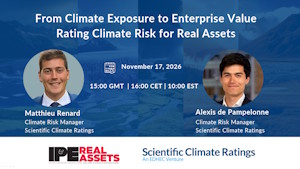
17 November: IPE Real Assets – From Climate Exposure to Enterprise Value: Rating Climate Risk for Real Assets, 15:00 GMT / 16:00 CET / 10:00 EST.
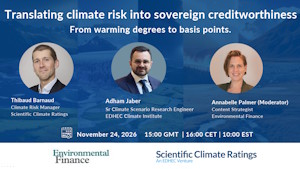
24 November: Environmental Finance webinar – Translating Climate Risk into Sovereign Creditworthiness, 15:00 GMT / 16:00 CET / 10:00 EST.
From exposure to value, from risk to resilience, our mission remains focused on quantifying the financial materiality of climate risk and helping investors steer capital towards a more resilient and sustainable future. If you’d like to see ClimateMetrics in action or discuss our ratings, our team would be glad to hear from you.
Thank you for reading, and see you in the next issue.
